
How Long Should Nails Be Under UV Light? The Right Timing for Flawless Gel Nails
Gel nails are one of the most satisfying beauty upgrades you can give yourself — glossy, strong, chip-resistant, and genuinely worth every minute of the process. But that process only works when one critical step is done correctly: curing under UV or LED light. Get the timing wrong in either direction and everything else you did falls apart.
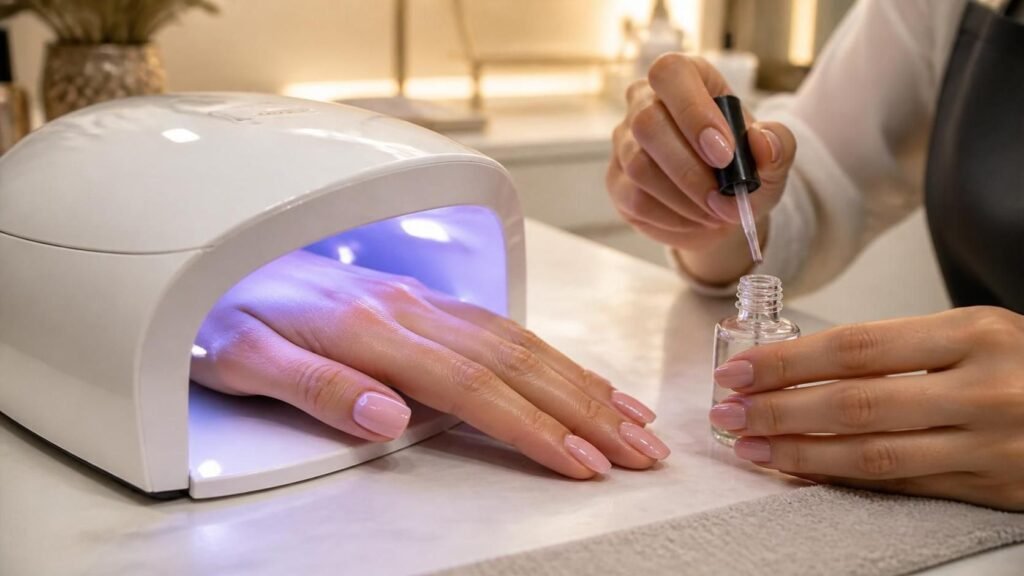
Too little time and the gel stays soft, peels early, or smudges the moment you touch anything. Too much time and you risk brittleness, heat discomfort, or dull finish. The good news is that once you understand the variables that affect curing time, getting it right becomes completely straightforward.
Below is a clear, practical breakdown of everything you need to know about UV light timing for perfect gel nails every single time.
Why UV Light Is Essential for Gel Nails
Gel polish is a completely different product category from regular lacquer, and the curing step is what makes it work. Unlike air-dry polish, gel contains special light-reactive compounds called photoinitiators that only harden when exposed to UV or LED wavelengths. Without that specific light exposure, the gel simply stays in its liquid state — no amount of waiting or blowing will change it.
This chemical reaction, known as curing or polymerization, is what transforms a tacky liquid layer into the hard, high-gloss surface that gel manicures are famous for. It is also what gives gel its impressive durability and chip resistance. Understanding that this process is chemistry — not just drying — helps explain why the right lamp, the right timing, and the right application thickness all matter so much.
Curing is a chemical reaction: Gel polish hardens through polymerization triggered by UV or LED light — it is a fundamentally different process from air-drying polish.
Lamp type determines curing speed: UV lamps work across all gel brands while LED lamps cure faster but require compatibility with specific photoinitiator formulas.
No shortcut exists: Skipping or shortening curing time does not produce a partially cured result — it produces a failed manicure that peels or smudges within hours.
Each layer cures separately: Base coat, color coats, and top coat each need their own individual curing cycle for the full manicure to hold properly.
This is the step that makes gel worth it: Proper curing is what gives gel its legendary two-to-three-week chip-resistant durability — everything else supports this one essential step.
How Long Should Nails Be Under UV Light?
The specific curing time for gel nails depends on whether you are using a UV lamp or an LED lamp, and the wattage of the device you are working with. These two lamp types operate on different wavelengths and deliver light at different intensities, which is why their curing times are so different from each other.
For standard UV lamps running at 36 watts, approximately two full minutes per coat is the reliable benchmark. LED lamps are significantly faster — most LED-compatible gel formulas cure in 30 to 60 seconds per coat under a quality LED lamp in the 24 to 48 watt range. Builder gels and thicker formulas may need slightly extended time regardless of lamp type. The most reliable guidance for any specific product is always the manufacturer’s instructions printed on the bottle itself, since formulas vary meaningfully between brands.
UV lamp timing: A 36-watt UV lamp needs approximately two minutes (120 seconds) per coat for complete, reliable curing across most gel formulas.
LED lamp timing: A quality LED lamp cures most compatible gel formulas in 30 to 60 seconds per coat — significantly faster than UV for daily use.
Builder gel exception: Thicker structured gels like builder or hard gel often require extended curing time — always check the product’s specific instructions carefully.
Read the bottle first: Different gel brands formulate their photoinitiators differently — the product label is always the most accurate curing time reference available.
When in doubt, add seconds: Slightly extending curing time by 10 to 15 seconds is safer than undercuring — just never exceed twice the recommended duration for a single coat.
Signs Your Nails Are Fully Cured
Knowing how to read your nails after curing is just as important as knowing the timing. Correctly cured gel has a specific set of characteristics that are easy to identify once you know what you are looking for. These signals tell you whether your timing and lamp are working together properly.
A fully cured gel coat feels completely firm and solid when you very gently press on the surface with a clean tool. There is no give, no indent, and no smudging at all. The surface has a consistent, uniform gloss across the entire nail without any dull patches or streaking. One thing to know: a slightly tacky surface immediately after curing does not always mean undercuring. Many gel formulas leave behind what is called an inhibition layer — a thin sticky film on the surface that is completely normal and is removed with a lint-free wipe soaked in isopropyl alcohol.
Firm to the touch: A properly cured nail feels completely hard with zero flexibility or soft spots when lightly pressed with a clean fingertip or tool.
No smudging at all: Press very gently on a cured nail — if it marks or smudges in the slightest, it needs more time under the lamp.
Consistent gloss finish: Fully cured gel has an even, uniform shine across the entire nail surface with no dull areas or streaky patches.
Tacky inhibition layer is normal: A sticky film after curing is expected with most gel formulas — wipe it away with isopropyl alcohol on a lint-free pad.
Check every finger individually: After removing your hand from the lamp, quickly check each nail rather than assuming all ten cured evenly in one session.
Can You Over-Cure Gel Nails?
Over-curing is a real concern that is less talked about than undercuring but equally worth understanding. Most people assume that longer lamp exposure automatically equals a stronger, better result — but past the optimal curing point, additional UV exposure creates problems rather than solving them.
Gel that has been over-cured becomes excessively rigid and loses its natural flexibility. This rigidity makes it more prone to cracking and chipping under normal daily stress because it cannot flex slightly with the natural nail movement the way properly cured gel does. Color gels are also vulnerable to heat and yellowing from prolonged exposure, which compromises the visual finish of the manicure. The heat spike — a burning or warming sensation during curing — that some people experience is often caused by excessive lamp intensity or too-thick layers rather than correct timing, and it is a signal to apply thinner coats or use a lower-wattage setting.
Over-curing causes brittleness: Excessively cured gel loses its flexibility and becomes rigid, which increases cracking and chipping during normal daily activities.
Color can shift or yellow: Prolonged UV exposure can alter the visual tone of color gels, particularly lighter or white shades that show discoloration most visibly.
Heat spikes signal a problem: A burning sensation during curing usually means layers are too thick or lamp intensity is too high — thin your coats and reassess.
Stick to recommended times: Adding significant extra curing time beyond the manufacturer’s recommendation creates diminishing returns and active quality problems.
Dullness after over-curing: Overexposed gel can lose its high-gloss surface finish and appear matte or uneven despite technically being hardened throughout.
Factors That Affect Curing Time
Curing time is not a single universal number — it shifts based on several interacting variables, and understanding each one helps you adapt your process to your specific equipment, products, and technique. Accounting for these factors is the difference between consistent results and unpredictable outcomes.
Lamp type and wattage are the primary variables. UV lamps cure all gel formulas but require more time, while LED lamps cure compatible formulas significantly faster but will not work with older formulas built for UV-only photoinitiators. The thickness of each applied layer has a direct relationship with cure time — thinner layers cure faster, more completely, and with far fewer problems than thick applications. The wattage of the lamp matters because a weaker lamp delivers less UV energy per second, meaning the same product needs proportionally more time to reach full cure. Finally, the specific gel formula matters — fast-cure gels, builder gels, and nail art gels all have different formulations with different curing requirements.
UV vs. LED lamps: UV works universally but slowly; LED is faster but only works with formulas containing compatible photoinitiators — check your gel’s compatibility.
Layer thickness is critical: Thin, even layers cure faster and more completely than thick applications — apply in two thin coats rather than one heavy coat always.
Lamp wattage affects intensity: A lower-wattage lamp delivers less UV energy per second, requiring extended time to achieve the same curing result as a higher-wattage model.
Gel formula variation: Fast-cure, builder, and art gel formulas are each engineered differently — never assume curing times transfer from one product to another.
Lamp age matters too: UV bulbs lose approximately 50 percent of their output intensity within six months of regular use — old bulbs require longer curing times to compensate.
Tips for Perfect Curing Every Time
Consistently great gel results come from a combination of the right equipment, the right technique, and a few key habits that experienced gel users develop over time. These practical tips address the most common curing mistakes and create a reliable process you can repeat with confidence.
Thin layers are the single most impactful technique improvement most home gel users can make. Thick, uneven applications do not cure properly at the center regardless of lamp time, while thin layers cure completely, bond more strongly, and look smoother on the nail. Hand placement inside the lamp matters more than most people realize — the entire nail surface needs to face the lamp bulbs directly for even curing, so flat placement with no fingers overlapping is essential. Equipment maintenance, particularly replacing UV bulbs on schedule, is the behind-the-scenes habit that keeps results consistent even as the lamp ages.
Always apply thin coats: Thin, smooth layers cure evenly all the way through — thick coats trap uncured gel underneath regardless of how long you leave them in the lamp.
Place hands completely flat: Lay your full hand flat inside the lamp so every nail surface faces the bulbs directly and receives equal UV exposure.
Replace UV bulbs every six months: Aging bulbs significantly reduce curing effectiveness — track your bulb usage and replace on schedule for reliable results.
Invest in a quality lamp: Professional-grade lamps deliver consistent wattage and even light distribution — budget lamps often have uneven output that creates patchy curing.
Cap the free edge: Apply gel to the very tip of the nail on every coat and cure carefully — unsealed edges are where peeling begins.
Health and Safety with UV Light Exposure
UV exposure during gel curing is brief but worth approaching thoughtfully, particularly for anyone who gets gel manicures frequently over a long period. Dermatologists have increasingly weighed in on this topic as at-home gel kits have become more popular, and the consensus is that simple protective measures make the curing process significantly safer without changing the outcome.
Applying a broad-spectrum SPF sunscreen to the backs of the hands before a gel session adds a meaningful layer of UV protection during curing without affecting the gel’s ability to bond to nails. Fingerless UV-protective gloves designed specifically for gel curing are widely available and allow all ten nails to cure normally while blocking UV from the surrounding skin. Neither option adds more than a few minutes to the process, and both provide peace of mind for frequent gel users.
Apply SPF before curing: A broad-spectrum sunscreen on the backs of hands before lamp exposure provides meaningful UV skin protection during every gel session.
Use UV-protective gloves: Fingerless curing gloves block UV from the skin surrounding the nails while leaving all ten nails fully exposed for complete curing.
LED lamps emit less UV: LED lamps produce a narrower wavelength spectrum with lower UV intensity than traditional UV lamps, making them slightly lower-risk for skin exposure.
Curing time is brief: Each curing session is measured in seconds to minutes — total cumulative UV exposure from gel curing is relatively low compared to outdoor sun exposure.
Moisturize after every session: UV light can be drying on skin — applying a good hand cream or cuticle oil immediately after curing keeps hands hydrated and healthy-looking.
Frequently Asked Questions
Q: Can I use a UV lamp for LED gel polish? It depends on the gel formula. Most modern LED gel polishes can also cure under UV lamps, but the curing time will be longer — usually around two minutes per coat rather than 30 to 60 seconds.
Q: What happens if gel nails are not cured long enough? Undercured gel remains soft, peels off quickly, smudges easily, and will not achieve the durability gel is known for. The tacky inhibition layer and genuine undercuring are different issues — only true undercuring produces premature peeling.
Q: Why do my gel nails feel hot under the lamp? Heat spikes during curing are usually caused by applying gel in layers that are too thick. The chemical curing reaction generates heat, and thicker layers produce more heat in a shorter time. Apply thinner coats to reduce or eliminate heat spikes.
Q: Does a more expensive UV lamp cure faster? Higher-wattage professional lamps do cure faster and more evenly than low-wattage budget models, but speed matters less than consistency. A quality lamp at the right wattage will always outperform a cheap lamp regardless of its listed specifications.
Q: Do I need to cure the top coat differently from the color coat? Top coat generally cures in the same time as color coat using the same lamp settings. Some no-wipe top coats and gel top coats with extra thickness may benefit from a slightly longer cure — always check the specific product instructions.
Q: How do I know if my UV lamp bulbs need replacing? Signs of aging bulbs include noticeably longer curing times, tacky or soft gel after the full recommended time, and dull finish on cured nails. Replace UV bulbs every six months with regular use even if they still light up.
The Difference Between UV and LED Lamps — And Why It Matters for Your Gel Results
Understanding the fundamental difference between UV and LED nail lamps is not just technical trivia — it directly affects the results you get from every single gel manicure. Many people use these terms interchangeably, but they describe different technologies with meaningfully different performance characteristics that affect curing time, compatibility, and long-term cost.
Traditional UV lamps use broad-spectrum ultraviolet bulbs that emit light across a wide range of wavelengths. This broad spectrum is why they work with virtually all gel formulas — they cover whatever wavelength any given gel’s photoinitiators respond to. The trade-off is slower curing and the need to replace bulbs every few months as their output intensity degrades. LED lamps use diodes calibrated to emit specific wavelengths that match the photoinitiators in modern gel formulas. This precision is what makes them so much faster — they deliver more effective curing energy per second. The limitation is that older or budget gel formulas sometimes use photoinitiators outside the LED spectrum, which means they will not cure properly under an LED lamp regardless of how long you leave them in.
For most people buying current gel products from reputable brands, an LED lamp is the more practical daily choice — faster, more energy-efficient, and with diodes that last significantly longer than UV bulbs. The best investment is a dual-wavelength lamp that combines both UV and LED output, curing any formula quickly and reliably without compatibility concerns.
Why Your Gel Manicure Is Not Lasting as Long as It Should
If your gel nails are consistently peeling, lifting, or losing their shine before the two-week mark, the curing process is usually at least partially responsible — even if the timing seems correct. Undercuring at the base coat level is particularly common and particularly damaging because it creates a weak foundation that every subsequent layer bonds to poorly, regardless of how perfectly those upper layers are applied and cured.
The most overlooked cause of premature gel failure is incomplete prep rather than the curing itself. If there is any trace of oil, moisture, or dust on the natural nail surface when gel is applied, adhesion is compromised before the first layer is even placed. Clean, dry, properly dehydrated nails are the essential starting point that makes correct curing time actually deliver its full potential. A 60-second dehydrating step with a nail prep solution before base coat costs almost nothing in time or money and significantly improves how long every gel manicure lasts.
Combining correct nail prep with accurate curing time appropriate to your specific lamp and gel brand produces the results that make gel manicures genuinely worth the effort — a flawless, high-gloss finish that stays beautiful for two to three weeks and comes off cleanly when it is time for a fresh set.
💡 Cure It Right: Because Perfect Gel Nails Start with Perfect Timing
The gap between gel nails that last three weeks and look salon-quality and gel nails that peel by day five almost always comes down to curing. It is the step that either locks everything in or lets everything fall apart — and now you have the complete picture of what makes it work.
Two minutes under a UV lamp, 30 to 60 seconds under LED, thin layers, the right lamp wattage, and a quick SPF application before you begin. These are not complicated steps — they are simply informed ones. Knowing why each detail matters makes it far easier to follow through on every single time.
Your gel manicure deserves to look as beautiful on day fourteen as it did the moment you stepped away from the lamp. Take the curing step seriously and it absolutely will. Save this guide, share it with your gel-obsessed friends, and go enjoy the most flawless set you have ever done.
