How to Apply Fake Nails Without Glue — 7 Damage-Free Methods That Work
Press-on nails are one of the best beauty shortcuts — instant length, perfect polish, zero waiting.
But nail glue puts a lot of people off, and for good reason — it can be harsh, messy, and hard to remove cleanly.
The good news is that glue is not the only way to wear fake nails beautifully and securely.
Several easy, widely available alternatives give you the same polished look without the damage or chemical concerns.
Whether you want nails for one night or a full week, there is a glue-free method that fits your needs perfectly.
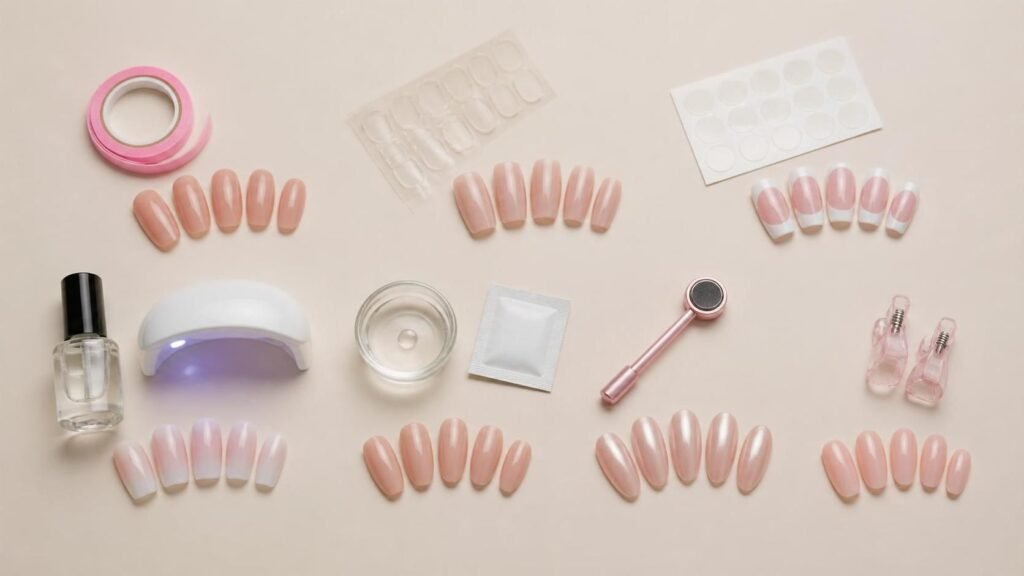
Below are 7 easy ways to apply fake nails without glue — covering everything from a few-hour fix to a semi-permanent hold.
Why Many People Choose to Skip Nail Glue
Nail glue is convenient, but it comes with trade-offs that are worth knowing before every application.
Most nail glues are cyanoacrylate-based — the same core adhesive found in industrial super glue — just in a cosmetic formulation.
For people with sensitive skin, recovering nails, or anyone who changes their nail looks frequently, glue-free alternatives are genuinely the smarter choice.
Damage tip: Repeated nail glue use thins the natural nail surface over time, especially during removal if done incorrectly or too often.
Removal tip: Nail glue requires acetone to dissolve fully — for people who remove and reapply press-ons often, that is a lot of dryness exposure.
Sensitivity tip: Some people experience allergic reactions or skin irritation from cyanoacrylate formulas, particularly around the cuticles and fingertips.
Flexibility tip: Glue-free methods allow you to change your nail look as often as you want without any commitment or recovery time between sets.
Understanding why glue-free is the better choice for many situations helps you pick the right alternative with confidence every time.
1. Double-Sided Adhesive Nail Tabs
Adhesive nail tabs are the most popular glue-free method for a reason — they are clean, easy, and genuinely effective.
They are thin double-sided sticky pads made specifically for press-on nails, available at most drugstores and beauty supply shops.
The application takes under five minutes and the hold is reliable enough for everyday wear.
Prep tip: Start with completely clean, dry, and oil-free nails — any residue on the nail surface will dramatically reduce how well the tab adheres.
Sizing tip: Match each tab to the nail carefully — a tab that is too small leaves edges lifting, while one that is too large can press onto skin and loosen faster.
Application tip: Press the tab flat against your natural nail first, peel the top film, then press the fake nail firmly for 10 to 15 seconds with steady even pressure.
Duration tip: Quality adhesive tabs keep fake nails secure for one to three days — ideal for weekends, events, photo shoots, or short-term wear.
Brand tip: Trusted brands like Kiss, imPRESS, and Static Nails produce tabs with the best adhesion-to-removal balance for natural nail safety.
Adhesive tabs are the go-to starting point for anyone new to glue-free fake nails — reliable, affordable, and widely available everywhere.
2. Clear Nail Polish as a Temporary Bond
A thick clear nail polish application works as a light temporary adhesive when you only need fake nails for a few hours.
It bonds the press-on to the natural nail through tack rather than a true chemical bond, which is exactly what makes removal so gentle.
This is the ultimate last-minute or test-run solution when nothing else is on hand.
Polish tip: Use a thicker, more viscous clear polish rather than a watery formula — the extra body creates a better temporary tack surface.
Timing tip: Apply the clear coat and press the fake nail on while the polish is still wet and tacky — waiting until it dries removes the bonding window entirely.
Hold tip: Press firmly and hold each nail for 30 full seconds — the compression while the polish is wet creates the strongest possible temporary bond.
Duration tip: Expect clear polish bonds to last a few hours to half a day — perfect for photos, quick events, or testing a new nail shape before committing.
Removal tip: Clear polish bonds release easily in warm water — a short soak loosens everything cleanly with zero damage to the natural nail.
It is not a long-wear solution but as a quick creative fix, clear polish is surprisingly effective and always right there in your kit.
3. Nail Adhesive Putty
Nail adhesive putty — sometimes called nail tack or press-on putty — is one of the most underrated glue-free tools available.
It works like the removable sticky tack used for posters but is specifically formulated to be safe and gentle for nail use.
It is the best option for people who want to switch their nail looks frequently without any chemical commitment.
Application tip: Roll a small ball of putty between your fingers to warm and soften it slightly, then flatten it gently across the natural nail before pressing the fake nail on top.
Pressure tip: Press the fake nail firmly for 15 to 20 seconds with consistent even pressure — the warmth from your fingers helps the putty grip both surfaces better.
Duration tip: Nail putty holds well for one to two days depending on hand activity — avoid extended water exposure for the strongest possible hold time.
Reuse tip: Press-on nails applied with putty can be removed, cleaned, and reapplied multiple times — making putty the most cost-effective glue-free option long term.
Activity tip: Avoid putty for physically demanding days or heavy water exposure — it performs best for lighter activity and is ideal for styling occasions rather than everyday wear.
For anyone who loves rotating nail designs and wants a truly commitment-free way to wear press-ons, nail putty is a genuine game changer.
4. Gel Adhesive Pads With UV Lamp Curing
Gel adhesive pads cured under a UV or LED lamp offer the longest-lasting glue-free hold available outside of a salon.
They create a flexible yet secure bond between the fake nail and natural nail that holds up through daily activities without any harsh chemicals involved.
This is the method to reach for when you want a longer wear result that still prioritizes nail health.
Pad tip: Position the gel pad carefully to cover the entire nail surface without touching the cuticle — contact with skin can cause lifting much faster.
Curing tip: Cure the gel pad under a UV or LED lamp for 30 to 60 seconds per nail — full curing is what creates the strong, flexible bond this method is known for.
Duration tip: Properly applied gel adhesive pads can keep fake nails secure for up to a full week with careful daily wear.
Product tip: Look for products labeled “UV gel nail stickers” or “semi-cured gel tabs” — these are purpose-built for this method and provide the most consistent results.
Removal tip: Use a cuticle stick to gently lift one edge of the gel pad after soaking nails in warm water for a few minutes — never pull directly from the tip.
Gel pads are the bridge between fully temporary and fully permanent — the best choice when you want impressive staying power without the commitment of traditional nail glue.

5. Builder Gel or Acrylic Base as Adhesive
If you already have nail supplies at home, builder gel or acrylic base used in tiny quantities can act as a nail-safe bonding agent.
This method gives a salon-quality hold without traditional nail glue and works especially well for people already comfortable with UV gel nail systems.
It is more involved than tabs or putty but offers an impressively strong and flexible result.
Application tip: Apply just a small dot of builder gel to the center of your natural nail — a thin layer bonds just as effectively as a thick one and is far easier to remove.
Curing tip: Place the fake nail firmly on top of the gel dot and cure immediately under a UV or LED lamp for 60 seconds for a secure flexible bond.
Removal tip: File the surface of the fake nail gently before soaking in acetone — never force or peel, which can thin the natural nail surface underneath.
Thickness tip: Use the thinnest possible layer of builder gel — thick applications create a stiffer bond that is harder to remove cleanly and can stress the natural nail.
Skill tip: This method works best for people with some existing gel nail experience — precision with product amounts makes a significant difference in the final result.
Builder gel as adhesive is a step up in technique but rewards you with a hold that feels genuinely professional without the long-term damage concerns of traditional glue.
6. Adhesive Nail Strips
Adhesive nail strips are peel-and-stick solutions designed specifically for applying fake nails quickly, cleanly, and without any liquid adhesive.
They work like thin sticker layers that you apply to the natural nail before pressing the fake nail on top.
They are beginner-friendly, mess-free, and clean up in seconds if something goes wrong during application.
Sizing tip: Cut strips to match your nail width precisely — a strip that extends beyond the nail edge will catch on things and cause the fake nail to lift prematurely.
Prep tip: Buff the natural nail surface lightly before applying strips — a slightly textured surface creates better adhesion than a completely smooth one.
Application tip: Smooth each strip from the cuticle line outward to remove air bubbles — trapped air is the most common reason adhesive strips lose hold quickly.
Duration tip: Strips perform best for short-term wear of one to two days — they are ideal for occasions where you want to swap designs frequently with minimal fuss.
Removal tip: Warm soapy water for a few minutes releases adhesive strips cleanly from both the fake nail and natural nail without any pulling or scraping.
Adhesive strips are the cleanest and most mistake-proof of all the glue-free methods — a perfect starting point for beginners trying press-ons for the first time.
7. Nail Tape or Crafting Adhesive Dots for Quick Fixes
When you genuinely have nothing else available and need a fake nail to hold for an hour or two, nail tape or small crafting adhesive dots will do the job.
These are not designed for nail use specifically but work surprisingly well for very short-term emergencies when something more purpose-built is not on hand.
Think of this as a bridge solution only — something to get you through a few hours until you can apply a proper method.
Tape tip: Cut a very small piece of double-sided tape to fit the nail surface precisely — any overlap onto skin will cause the fake nail to shift almost immediately.
Dot tip: Use the smallest crafting adhesive dot that covers the center of the nail — a single centered dot holds better than multiple small ones placed haphazardly.
Activity tip: Limit hand activity to light tasks only when using tape or dots — these methods are not designed to withstand water, heat, or physical pressure.
Duration tip: Realistically expect tape and dots to hold for two to four hours maximum under gentle conditions — replace with a proper method as soon as possible.
Removal tip: Both methods release easily without any soaking — simply slide a thin tool under the edge of the fake nail to lift it free without any pulling.
Think of nail tape and dots as the beauty equivalent of a safety pin — not the ideal solution, but a genuinely useful one when nothing else is available.
How to Remove Glue-Free Fake Nails Without Causing Damage
The best advantage of every glue-free method is how cleanly and gently the nails come off when you are ready to remove them.
None of these alternatives require acetone soaking, forceful peeling, or any technique that puts stress on the natural nail beneath.
A simple consistent removal routine protects your nails and keeps them in great condition between applications.
Water tip: Soak fingertips in warm soapy water for three to five minutes before removal — this softens virtually all glue-free adhesives and makes lifting effortless.
Tool tip: Use a wooden cuticle stick to gently lift one edge of the fake nail rather than trying to peel from the tip, which can flex and stress the natural nail.
Patience tip: Work from one edge slowly across the nail rather than trying to pop the whole fake nail off at once — gradual removal is always the gentler approach.
Aftercare tip: Apply cuticle oil to every nail immediately after removal — even gentle adhesives pull some moisture from the nail surface and oil restores it quickly.
Reuse tip: Clean removed press-ons with a cotton pad and isopropyl alcohol and store them flat — glue-free methods often preserve the fake nail for multiple wears.
Frequently Asked Questions
Q1: How long do fake nails last without glue? It depends entirely on the method. Adhesive tabs and strips last one to three days. Nail putty holds for one to two days. Gel adhesive pads cured under UV light last up to a week. Clear polish and tape or dots are short-term fixes designed for a few hours only.
Q2: Do fake nails without glue fall off easily? With proper prep — clean dry nails, correct sizing, and firm application pressure — glue-free methods hold reliably for their intended duration. The most common cause of early lifting is skipping prep or applying adhesive tabs over moisturized skin rather than completely dry nails.
Q3: Can you shower or wash dishes with glue-free fake nails? Water exposure reduces the hold of most glue-free methods. Adhesive tabs and gel pads tolerate brief water exposure well. Nail putty and clear polish bonds are more sensitive to moisture. Wearing gloves for dishes and keeping showers brief extends wear time significantly for all methods.
Q4: Are adhesive tabs safe for natural nails? Yes — quality adhesive tabs are specifically formulated to be gentle on natural nails. They do not thin the nail plate, require no acetone for removal, and leave no residue when removed correctly after a brief warm water soak.
Q5: Can I reuse press-on nails applied without glue? Absolutely — this is one of the biggest advantages of glue-free methods. Press-ons applied with putty, tabs, or gel pads often come off cleanly enough to be worn multiple times. Clean them with isopropyl alcohol between uses and store them flat to preserve their shape.
Q6: Which glue-free method holds the longest? UV gel adhesive pads offer the longest hold of all glue-free methods — up to seven days with proper application and careful wear. Builder gel used in tiny quantities comes close. For anyone who needs extended wear without traditional glue, gel pads are the clear best choice.
The Press-On Revolution Nobody Saw Coming
A few years ago, press-on nails had a reputation as the backup plan — something you grabbed when you ran out of time for a real manicure.
That reputation has completely shifted. Today’s press-on market offers salon-quality designs in every shape, length, and finish imaginable, and the glue-free application methods have evolved right alongside them. What was once a temporary fix is now a fully legitimate manicure choice for people who value flexibility, nail health, and effortless style equally.
Glue-free application is at the center of that shift. It removed the main barrier — the damage concern — and made press-ons accessible to anyone who wants beautiful nails without the commitment. Whether you use tabs for a weekend look or gel pads for a week-long wear, you are part of a nail care approach that genuinely puts your natural nail health first.
Press On, Glow Up
Beautiful nails should never come at the cost of healthy ones — and with these seven glue-free methods, they absolutely do not have to.
Pick the method that fits your lifestyle, your timeline, and your confidence level, and give it a proper try with clean nails and the right prep.
The results will surprise you — a secure, polished look that comes off just as cleanly as it went on.
No glue. No damage. Just gorgeous nails exactly when and how you want them.