
Hairstyles With Bangs for Older Women: 19 Flattering Ideas
A lot of women hesitate to try bangs after a certain age — usually because they have seen them go wrong before. Too stiff. Too blunt. Too much to deal with every single morning. But that is rarely a bangs problem. It is almost always a cut problem. When the fringe is shaped to work with your hair’s natural texture and density, the whole thing changes. Soft edges, better blending, and a relaxed finish can frame your eyes, balance your features, and make your overall look feel more polished without any dramatic effort.
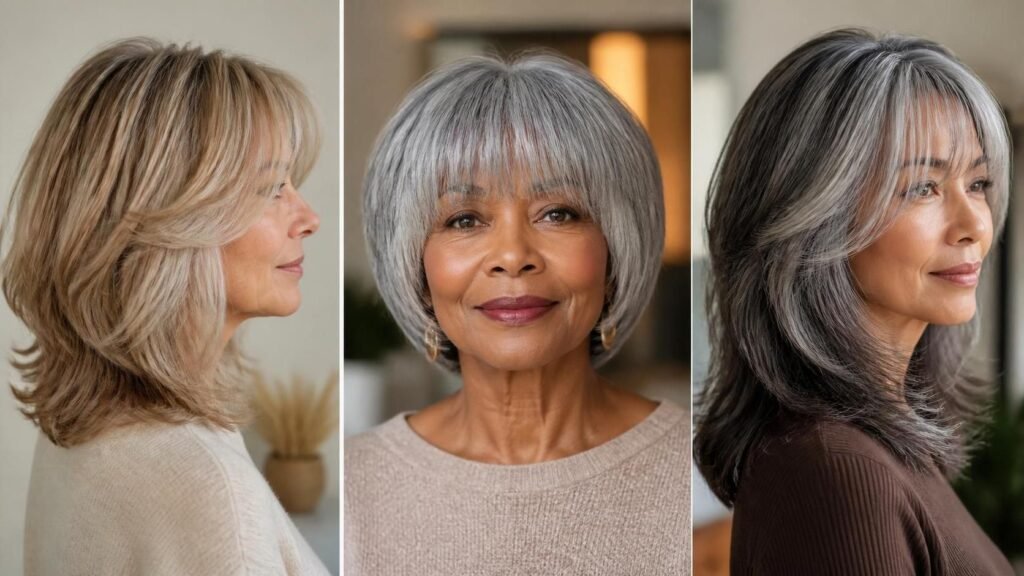
The key is choosing a style that suits your lifestyle, not just a trend. Some of these looks are gentle and understated, while others make a real impression — but every one of them is designed to feel wearable, not forced.
Below are 19 hairstyles with bangs for older women, chosen for their flattering shape, easy maintenance, and real-life elegance.
1. Soft Blowout with Full Bangs
A smooth blowout paired with full bangs strikes a balance that feels put-together without going over the top. The structured lengths give the style its polish, while the bangs resting just above the brows add a soft, face-framing detail. It never looks overdone because the bangs have just enough weight to sit still without feeling stiff. This is one of those styles that photographs beautifully and holds up just as well in person.
Best for: Medium-density hair that needs structure but still wants a little movement throughout. Fringe tip: Keep the bang length just above the brows — sitting on or below the brow can feel dated. Styling: Blow dry the bangs forward with a flat brush, rolling slightly under at the ends for a polished finish. Density tip: If hair is on the thinner side, ask for point-cutting through the bang to reduce bulk without losing coverage. Grow-out: Full bangs grow out cleanly and can transition into a longer, sweepable fringe over six to eight weeks.
2. Layered Blowout with Wispy Fringe
Long layers and a light, airy fringe are a combination that rarely disappoints. The layers keep the ends from feeling heavy, while the wispy bangs stay flexible and easy to move throughout the day. What makes this work for older women is how forgiving it is between salon visits — the fringe blends into the sides naturally, so there is no harsh line when it starts growing out. It rewards low-effort styling and still looks intentional.
Best for: Women who like to style their hair but want something that forgives an off-day. Layer tip: Ask for long layers starting at the cheekbone level so they add movement, not just weight removal. Fringe tip: Wispy fringes should be cut with shears held vertically so the ends stay soft and transparent. Styling: Rough dry with fingers, then use a round brush on the fringe only for a polished focal point. Grow-out: Wispy fringes blend seamlessly into the sides as they grow, making upkeep feel low pressure.
3. Blunt Bangs with Natural Texture
Blunt bangs often get dismissed as too severe, but when the rest of the hair has honest, natural texture, the contrast actually works beautifully. The defined front draws attention straight to the eyes, and the relaxed texture through the lengths stops the cut from feeling boxy or rigid. The trick is to ask for bangs that are cut just slightly imprecise — not a ruler-straight line, but one that settles naturally as it dries.
Best for: Women with straight to lightly textured hair who want a modern, graphic-inspired look. Cut tip: Ask for very slight point-cutting at the ends of the bang so it looks natural rather than scissor-straight. Length tip: Blunt bangs look most elegant when they sit just at or barely above the brow line. Styling: Blow dry the bangs straight and flat, then leave them alone — over-touching makes them separate. Grow-out: Blunt bangs can transition into a softer, sweepable fringe as they reach the bridge of the nose.
4. Casual Updo with Soft Bangs
There is something effortlessly chic about hair pulled back loosely while soft bangs frame the face at the front. It is a practical style that looks more styled than it actually is. The bangs do all the face-framing work while the rest of the hair stays out of the way. This combination suits busy days, warm weather, and every occasion where you want to look polished without fussing too much.
Best for: Women with straight or lightly wavy hair who want an easy, adaptable everyday look. Bang tip: Keep bangs slightly longer and softer so they work whether worn with the hair up or down. Updo tip: A loose low bun or twisted knot at the nape pairs especially well with soft, forehead-skimming bangs. Styling: Let the bangs air dry or blow dry quickly with fingers for a natural, unfussy finish. Grow-out: Longer, softer bangs grow out gradually and can be swept to the side without any awkward phases.
5. Natural Curls with Short Fringe
Curly hair and bangs are a genuinely great pairing when the fringe is cut to respect the curl pattern rather than fight it. A short fringe sits lightly across the forehead and blends into the curls at the temples, making the whole style look balanced and intentional. The key is having the bangs cut on dry hair so the stylist can see exactly how each curl will spring up and settle.
Best for: Women with natural curls who want a defined, modern look without changing their texture. Cut tip: Always ask for dry cutting on curly bangs — wet cutting makes it impossible to gauge the final length. Volume tip: Keep the bang section narrow so curls do not create too much mass at the front. Styling: Apply curl cream to damp bangs, scrunch gently, and let them dry naturally alongside the rest of the curls. Grow-out: Curly fringes grow out into a natural, rounded shape that continues to look intentional with minimal effort.
6. Soft Curls with Curtain Bangs
Curtain bangs are one of the most universally flattering bang styles, and they are especially lovely when paired with soft, natural curls. They part effortlessly in the center, fall to either side of the face, and create a gentle frame that opens up the eyes and cheekbones at once. The fact that they grow out so gracefully makes them one of the lowest-commitment bang options available.
Best for: Women with wavy or curly hair who want face-framing bangs with very little daily maintenance. Part tip: Let curtain bangs fall where they naturally part — forcing them looks less polished than letting them settle. Volume tip: Keep the sides of the cut from getting too full so curtain bangs have room to frame rather than get lost. Styling: Scrunch with curl cream and air dry completely before separating any pieces to avoid frizz. Grow-out: Curtain bangs are possibly the easiest bang style to grow out — they simply blend into long layers.
7. Straight Hair with Classic Curtain Bangs
On straight hair, curtain bangs have a clean, almost cinematic quality. They sit longer at the sides and taper slightly toward the center, which opens the face without boxing it in. This is an especially reliable choice for older women because the soft parting at the center avoids any line across the forehead that might draw attention to fine lines. It is a low-maintenance choice that looks high-effort.
Best for: Women with straight or very lightly wavy hair who want an elegant, long-lasting bang style. Length tip: Curtain bangs on straight hair look best when they reach the outer corner of the eye at their longest point. Styling: A quick pass with a round brush while blow drying is usually enough to get a clean, smooth finish. Texture tip: If hair is very fine, use a light volumizing spray at the roots before drying to keep bangs lifted. Grow-out: These bangs blend naturally into long face-framing layers as they lengthen.
8. Feathered Bangs with Layered Length
Feathered bangs have a softness that very few other bang styles can match. Rather than sitting flat on the forehead, they skim it lightly — almost floating — which creates a naturally fuller look at the front. Paired with gentle layers through the lengths, this style gives fine hair some much-needed dimension without relying on heavy product or complicated styling. It is an understated choice that holds up beautifully.
Best for: Women with fine or thinning hair who want bangs that add the appearance of volume and fullness. Cut tip: Feathered bangs need vertical scissor work through the entire section to create that light, layered effect. Layer tip: Make sure layers throughout the rest of the cut match the lightness of the fringe for a seamless finish. Styling: Blow dry bangs forward and slightly upward to maximize the feathered lift at the front. Grow-out: Feathered bangs grow out into longer, piecey layers that can be worn swept or free.
9. Lightweight Bangs with Soft Movement
These bangs are for women who want coverage and framing without any heaviness at the front. They move easily in a breeze, respond to natural texture without needing to be tamed, and do not require much attention to look good. The key is cutting them slightly longer than you might expect — a longer fringe naturally blends into the sides and avoids that rigid, painted-on look.
Best for: Women with thinner hair who want bangs that add definition without overworking the front section. Length tip: Cutting lightweight bangs just to or past the brow gives them room to blend naturally. Density tip: Ask for the bang section to stay relatively narrow so it does not look sparse or transparent. Styling: Air drying works beautifully for this style — a quick finger-comb is usually all that is needed. Grow-out: Lightweight bangs have such a natural fall that the grow-out phase is almost invisible.
10. Long Layered Waves with Soft Fringe
Long, flowing waves with a soft fringe give off a relaxed, grown-in elegance that feels timeless rather than trendy. The fringe sits loosely and naturally, blending into the waves at the temple without any sharp transition. Women who prefer length but still want some detail at the front will find this combination particularly satisfying — it adds just enough focus near the face to make the whole look feel intentional.
Best for: Women who love longer hair and want a subtle fringe that adds face-framing interest. Fringe tip: Keep the fringe long, loose, and slightly layered so it blends into the waves naturally. Wave tip: Soft, relaxed waves created with a large-barrel iron complement this fringe better than tight curls. Styling: After styling waves, gently separate the fringe with a little texturizing cream for a natural, loose finish. Grow-out: Because the fringe is already long and blended, growing it out further is virtually seamless.
11. Long Side-Swept Bangs
Long side-swept bangs are one of the most reliable options in this whole lineup. They soften the hairline, gently cover the forehead without dominating it, and grow out in a way that never looks untidy. The diagonal angle of the sweep is a natural face-framing shape that flatters nearly every face structure. They work with almost any hair length and texture, which makes them a universally safe choice.
Best for: Women who want a subtle, flattering bang style that is genuinely easy to maintain and grow out. Angle tip: The sweep should follow the natural brow line rather than cutting across it at an artificial angle. Styling: Blow dry the bangs in the direction of the sweep while still damp — they will hold the shape all day. Product tip: A tiny bit of smoothing serum through the bang keeps flyaways down without making it look stiff. Grow-out: Side-swept bangs grow out into face-framing layers that blend completely with no awkward stage.
12. Long Silver Hair with Soft Bangs
Silver hair worn long can sometimes feel heavy or severe — soft bangs are one of the most effective ways to balance that. They interrupt the solid column of length with a gentle horizontal detail at the forehead, which adds visual interest and immediately draws focus up toward the eyes and cheeks. This look feels intentional and composed, especially when the hair is worn with its natural texture rather than over-styled.
Best for: Women with long silver or gray hair who want to add elegance and face-framing without a major cut. Color tip: Keep silver tones cool and bright with a purple toning shampoo used once or twice a month. Bang tip: Soft bangs for silver hair should be blended rather than defined — a freehand cut works beautifully. Styling: Minimal product is best here — a light smoothing spray through the lengths and nothing on the bangs. Grow-out: Soft, blended bangs grow out naturally and can extend into the sides without any noticeable transition.
13. Loose Wispy Bangs
Loose wispy bangs are the hairstyle equivalent of barely-there jewelry — they do not announce themselves, but the look would feel incomplete without them. They move freely, never look overdone, and work with the natural fall of the hair rather than imposing a shape on it. For older women who are curious about bangs but not ready for a full commitment, this is the ideal starting point.
Best for: Women who want a gentle introduction to bangs without any dramatic change to their overall look. Cut tip: Wispy bangs should be cut with shears held at a diagonal to create soft, see-through ends. Length tip: A longer wispy fringe that falls past the brow is more forgiving than a shorter, blunter version. Styling: Let these bangs air dry and fall where they want — fighting their natural movement defeats the purpose. Grow-out: Because they are already long and light, wispy bangs grow out with absolutely no awkwardness.
14. Separated Bangs with Soft Texture
Separated bangs look like they happened naturally rather than being styled into place, and that is exactly the appeal. The spaces between the pieces of fringe let the forehead breathe and keep the front from looking solid or flat. The overall effect is lighter, more modern, and less fussy than a traditional bang style. This is a great option if you want movement and dimension right at the front of your face.
Best for: Women who want bangs that feel casual, textured, and effortlessly modern rather than structured. Cut tip: Ask for soft point-cutting through the bang section so natural separation happens on its own. Product tip: Work a tiny amount of lightweight paste between fingertips and press lightly through the bang for definition. Texture tip: This style looks best on hair with some natural texture — it can fall flat on very fine, straight hair. Grow-out: Separated, piecey bangs grow out into a natural fringe that continues looking good with zero effort.
15. Side-Swept Bangs with Soft Layers
When side-swept bangs are combined with soft layers through the rest of the cut, everything works together as one cohesive shape rather than two separate elements. The bangs and layers create a continuous flow that frames the entire face, not just the forehead. This combination is one of the most forgiving and versatile styles on this list — it suits fine hair, thick hair, straight or wavy, and almost any face shape.
Best for: Women with any hair type who want a reliable, flattering style that grows out gracefully. Layer tip: Layers should start near the face and get progressively lighter toward the ends for a natural flow. Bang tip: The sweep should be long enough to reach the outer corner of the eye for maximum face-framing effect. Styling: Blow dry in the direction of the sweep, then run fingers through the layers for a relaxed, natural finish. Grow-out: Both the bangs and the layers grow out in the same direction, keeping the style cohesive throughout.
16. Classic Side-Swept Fringe
There is a reason the classic side-swept fringe has never gone out of style — it is endlessly adaptable, genuinely low-maintenance, and flattering on virtually everyone. It blends seamlessly into the rest of the cut and requires next to no styling to look presentable. If you are after a quiet refresh rather than a noticeable transformation, this is exactly the right choice.
Best for: Women who want a reliable, timeless fringe style that requires minimal effort and suits any occasion. Styling: A quick blow dry in the sweep direction while hair is still damp is all this style ever needs. Versatility tip: This fringe works beautifully whether hair is worn down, half-up, or pulled back completely. Color tip: A classic side sweep looks especially striking in silver or salt-and-pepper tones — no color required. Grow-out: Side-swept fringes grow out into long face-framing pieces that are easy to pin back or blend in.
17. Soft-Cut Bangs with Natural Shape
Soft-cut bangs let the hair decide where it wants to sit rather than forcing it into a predetermined shape. They follow the natural fall of the hair, settle comfortably across the forehead, and blend into the sides without any obvious transition line. The result is a bang that feels like it was always part of the haircut — organic, unhurried, and genuinely easy to live with every single day.
Best for: Women who want bangs that feel natural and effortless rather than styled or precision-cut. Cut tip: Ask for a freehand cut rather than a comb-guided cut — it creates a much more natural result. Density tip: Keep the bang section wide enough to cover the forehead comfortably but not so wide that it looks heavy. Styling: Air drying works perfectly for soft-cut bangs — a quick shake of the head is all the styling needed. Grow-out: Because the shape is already soft and organic, growing these bangs out is an effortless process.
18. Soft Wispy Bangs with Light Movement
These wispy bangs offer just the right amount of coverage — enough to soften the forehead and frame the face, not so much that they feel like something that needs constant managing. They move with the head rather than staying fixed in place, which gives the whole look an easy, natural energy. They are ideal for days when you want your hair to feel finished without spending any real time on it.
Best for: Women who want a soft fringe that requires no precision styling and suits a relaxed daily routine. Density tip: Very fine, wispy bangs look best when the hair has some natural texture — add a little dry shampoo if needed. Length tip: Allow these bangs to reach just past the brow for the softest, most flexible result. Styling: Scrunch lightly with fingers after towel drying and let them fall naturally — no blow dryer needed. Grow-out: Light, wispy bangs are among the easiest to grow out — they simply extend into the rest of the hair.
19. Wispy Bangs with Long Texture
Pairing wispy bangs with longer textured lengths creates a beautifully balanced look where nothing feels too heavy or too sparse. The fringe stays light and breezy at the front while the longer hair adds softness and movement around the face and shoulders. Together they create a style that feels feminine, natural, and completely current — without requiring anything more than a good cut and a bit of air drying.
Best for: Women who prefer longer hair and want a fringe that adds face-framing interest without disrupting the overall length. Fringe tip: Keep wispy bangs blended with the lengths so there is no visible separation between the fringe and the sides. Texture tip: Longer textured hair pairs especially well with undone, air-dried texture rather than a sleek blow-out. Styling: Apply a light leave-in conditioner through damp lengths, then scrunch the bangs lightly and leave everything to dry. Grow-out: Because the bangs are already long and blended with the rest of the hair, growing them out is completely seamless.
FAQs
Do bangs make older women look younger or older? Bangs done right can genuinely lift the face and draw attention to the eyes, which tends to read as fresh and youthful. What causes problems is weight and placement — heavy, blunt bangs can look dated, while soft, blended styles almost always flatter.
What bang style is easiest to maintain after 50 or 60? Side-swept and curtain bangs are the most forgiving options because they grow out naturally and do not need daily precision styling. Wispy and soft-cut styles are a close second for low-effort upkeep.
Can women with fine or thinning hair wear bangs? Yes, with the right cut. Lightweight, feathered, or wispy bangs work especially well on fine hair because they add a visible detail at the front without taking too much density. Avoid dense, blunt fringes which can look sparse as they separate.
How often do bangs need to be trimmed to stay looking neat? Most bang styles need a light trim every three to five weeks to stay at their optimal length. Wispy and side-swept styles can stretch longer between trims because the grow-out looks intentional rather than overgrown.
Are curtain bangs a good choice for older women? Curtain bangs are one of the most universally recommended styles for older women. They open up the face, suit almost every face shape, work across straight, wavy, and curly textures, and grow out more gracefully than nearly any other bang style.
What should I tell my stylist to make sure the bangs look soft and not severe? Say “soft, blended fringe” rather than “bangs.” Ask for point-cutting or freehand cutting rather than a straight scissor line. Request that the bang section be kept light, and specify that you want them to blend into the sides rather than sit as a separate element.
The Real Reason Bangs Feel Different After 50
Hair changes over time — texture shifts, density decreases, and the way hair falls can feel completely different from how it behaved twenty years ago. Bangs that worked well in your 30s might not sit the same way now, but that is not a reason to avoid them. It is actually an invitation to choose a softer, more relaxed version of whatever you loved back then. The right fringe today works with your current texture rather than against it, and the result often looks more natural than anything precision-cut ever did.
A lot of women discover that their 50s and 60s are the time they finally stop overthinking their hair and start making choices based on what genuinely suits them. Bangs become less about a look and more about a feeling — and when that clicks, the right fringe feels completely effortless.
✨ The Right Fringe Finds You When You Stop Overthinking It
The 19 styles above cover everything from barely-there wisps to more defined fringes, and all of them were chosen with wearability in mind. There is no single right answer — just a range of options that suit different textures, lifestyles, and comfort levels with change. Save the ones that caught your eye and bring them to your next appointment.
Be specific when you talk to your stylist. Say what you like about the reference photo, what you want to avoid, and how much time you realistically spend on your hair each morning. That conversation will get you closer to something you genuinely love than any trend ever could.
Bangs are not something you have to earn the right to wear. At any age, the right fringe is simply the one that feels like you.
Go find yours.
